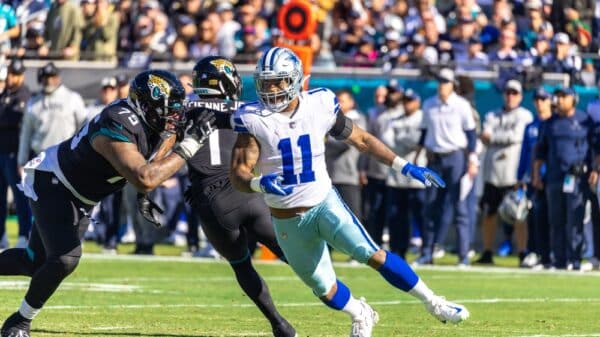















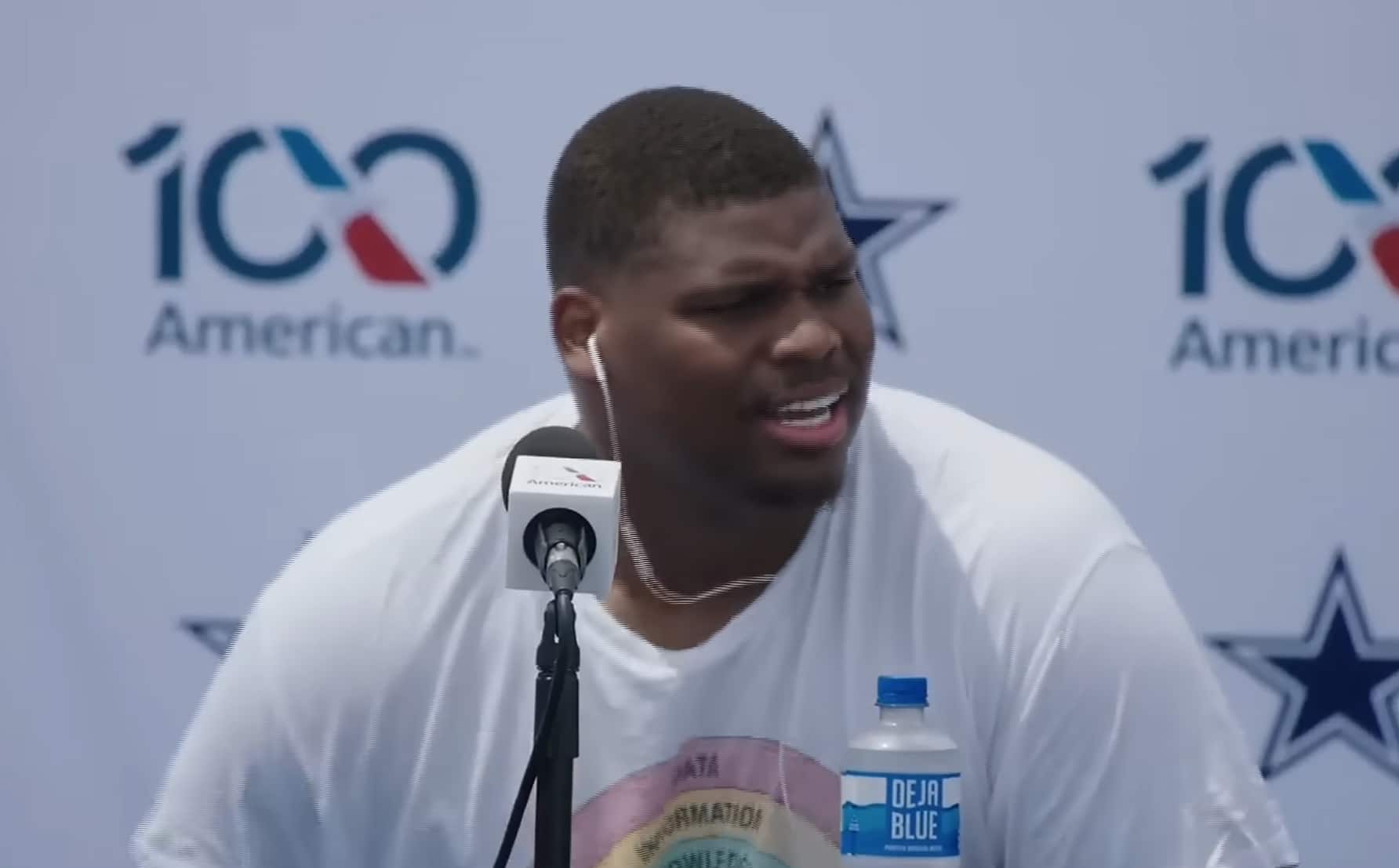
While the Dallas Cowboys typically prefer to wait until the eleventh hour for contract extensions, the front office appears to be breaking character regarding star defensive tackle Quinnen Williams. In a surprising departure from their usual “wait-and-see” philosophy, Cowboys chief operating officer Stephen Jones confirmed at the onset of training camp that preliminary discussions have already begun with Williams’ representative, Nicole Lynn.
Jones expressed a strong desire to secure the interior anchor for the long term, noting that the organization has invested significant capital into him and views him as a cornerstone of their defensive front. For his part, Williams has echoed that commitment, stating that while he hopes to remain in Dallas, his primary focus remains on pursuit of a championship rather than the specifics of his next payday.
Currently, the 28-year-old Williams has two seasons remaining on the massive four-year, $96 million extension he originally signed with the New York Jets in 2023. Under his current terms, he is set to earn a base of $21.75 million this season, with that figure climbing to $25.5 million by 2027.
Historically, the Cowboys rarely engage in extension talks when a player has two years left on their deal. Notable exceptions usually involve high-leverage situations, such as Ezekiel Elliott’s 2019 holdout. More recently, the team made waves by making Tyler Smith the league’s highest-paid interior lineman last September, but that deal was finalized just as the regular season was kicking off. With Williams, the Cowboys seem to be acknowledging that the market is moving faster than their traditional timeline.
Analyzing the Rapid Inflation of the Interior Defensive Line Market
Even with an accelerated timeline by Dallas standards, the Cowboys find themselves reacting to a market that has already shifted beneath them. For a period, the market for interior defensive linemen remained relatively flat after Chris Jones signed his $31.75 million-per-year deal with Kansas City in early 2024. However, that stability was short-lived.
A massive correction was inevitable as the wage gap between elite edge rushers and interior defenders became too wide to ignore. In 2025 alone, the top-end market for edge rushers surged by nearly 37%, reaching an annual average of $46.5 million. By failing to move sooner, Dallas allowed several other high-profile deals to reset the baseline for Williams’ future demands.
| Elite Interior Defender | Organization | Contract Structure | Annual Average Value | Impact on Williams’ Valuation |
|---|---|---|---|---|
| Jalen Carter | Eagles | New Extension | $38 million | Establishes the current ceiling for the position |
| Jeffery Simmons | Titans | New Extension | $35.276 million | Sets a realistic salary floor for Williams |
| Chris Jones | Chiefs | New Contract | $31.75 million | The initial catalyst for the market reset |
| Dexter Lawrence | Bengals | Short-term Extension | $28 million | Incremental step that kept the market climbing |
| Jordan Davis | Eagles | New Extension | $26 million | Demonstrated Philadelphia’s proactive strategy |
| Quinnen Williams | Cowboys | Existing Deal | $24 million | Now represents a significant bargain compared to peers |
The Proactive Philosophy: Comparing Dallas to Philadelphia
The contrast in management styles between the Cowboys and the Philadelphia Eagles is stark. Under GM Howie Roseman, the Eagles have prioritized signing core talent years before they reach free agency. This proactive approach helped fuel their consistent success throughout the 2000s and was instrumental in their Super Bowl runs in LII and LIX.
Roseman’s track record includes early extensions for key pillars like Lane Johnson and DeVonta Smith. He even surprised the league by reworking Saquon Barkley’s contract after just one season in Philly, making him the NFL’s first $20 million-per-year running back. By being the first to the table, Philadelphia often sets the market rather than being forced to pay the premium that comes after other teams have weighed in.
Dallas, conversely, often finds itself playing catch-up. When the Eagles extended Jordan Davis and subsequently Jalen Carter—who signed a record-breaking $152 million deal with over $106 million guaranteed—it essentially locked the Cowboys into a much higher price point for Williams. The moment Carter’s deal was inked, the “discount” window for Williams officially slammed shut.
Why Williams Holds Immense Negotiating Leverage
The Cowboys’ leverage is further weakened by the sheer volume of assets they surrendered to acquire Williams from the Jets. Giving up a second-round pick, a future first-rounder, and a former first-round selection in Mazi Smith indicates that Williams was never intended to be a rental. His performance has only validated that price tag; since arriving in Dallas, his 16.3% pressure rate and 14% run-stop percentage have ranked him among the most efficient interior defenders in the league.
The decision to trade Osa Odighizuwa to San Francisco earlier this year further signals that the Cowboys are all-in on Williams. While this move cleared a logjam on the depth chart, it also removed any alternative options the team might have used as leverage in negotiations. Additionally, the recent $35 million-per-year extension given to Jeffery Simmons—who also had two years left on his deal—serves as a direct blueprint for Williams’ upcoming contract.
With Seattle likely facing a massive bill to keep Leonard Williams off the open market, the price for elite defensive tackles is only going up. Quinnen Williams, a First-Team All-Pro and recently voted the league’s top DT by NFL insiders, has every reason to demand a contract that reflects his status as the premier player at his position.
The Impact of High-Stakes Representation
It is expected that agent Nicole Lynn will push for Williams to become the highest-paid defensive tackle in NFL history. Lynn has a proven track record of maximizing value for players acquired via high-profile trades, a trend seen with stars like Jalen Ramsey and Laremy Tunsil.
Lynn is currently on a record-breaking streak, having secured a $50 million-per-year deal for Will Anderson Jr. and resetting the running back market with Bijan Robinson’s extension in Atlanta. For Williams, the Jeffery Simmons deal represents the absolute floor. If Lynn follows her recent patterns, she will likely aim for a deal north of $36 million per year, potentially pushing toward the $40 million mark if the Cowboys continue to delay.
Summary: While the Dallas Cowboys have expressed a clear desire to keep Quinnen Williams, their reactive approach to the market has likely cost them millions. By allowing Philadelphia and Tennessee to set the new standard for interior defensive linemen, Dallas has turned what could have been a $30 million-per-year conversation into a pursuit of a record-breaking $36 million-to-$40 million-per-year extension. As the 2027 salary cap looms, the price for elite defensive talent will only continue to escalate, making a timely deal a necessity rather than a luxury for the Cowboys’ front office.